1.2 billion people across the developing world have no choice but to live off just £1 every day. One pound may seem like nothing to us but can be everything for those living close to hunger. This Thursday until next Monday I will be teaming up with ‘Live Below the Line’ and living off just £1 a day for all of my drink and food. Not only am I doing this to challenge myself but I am also raising money for Raleigh International, a great charity that sends 1,000’s of volunteers every year to help those in developing countries learn new skills and combat poverty.
On 20th June I will be off to Tanzania with Raleigh to work 7 days a week on projects alongside rural communities. Some of the work I will be doing here will range from helping local dairy farmers to increase their yields, working to improve water sanitation and teaching young Tanzanian entrepreneurs about how they can turn their business dreams into a reality.
Over the next few days as I embark on Living below the line I will be updating this page with how I am getting on. I am looking to raise £500 within the next 3 weeks so that Raliegh can continue the great work they do in helping to improve the lives of those in extreme poverty from Tanzania and Borneo to Nicaragua and India. You can help me on my journey by giving anything you can here: https://www.justgiving.com/Stephen-Bowcott/
I’m incredibly thankful for any help you can give 🙂
I am now halfway through my internship this summer at the British Consul-General in Chicago, one of the many UK diplomatic posts spread throughout the world that helps enable our geographically small country punch well above its weight on the global stage. Below is a summary of my time here so far, I’ll focus more on the work I have been doing so far as that will be of best help to future applicants. It is one of the few areas in life a Google search cannot help with!
I arrived here on the 23rd July, a good few days before my actual internship started so I could adjust to my new accommodation and get to explore the city. The first thing that really hits you as you make your way along the blue line subway line from O’Hare International Airport is the sheer diversity of the people that take pride in calling themselves Chicagoans. I can recall at least 6 different languages I encountered in that initial 40 minute journey to my accommodation at the University of Illinois at Chicago (UIC).
Once at my accommodation I straight away met my flatmate and it wasn’t long before we were discussing the intricacies of UK-US politics in between my unsuccessful attempts to explain to him that skins is not an accurate representation of UK teen culture! We soon set off to explore the city; we did however get a bit lost on the way back and ended up exploring Chicago’s South Side around 10pm (not something I would recommend for your first night!).
Before long it was soon Monday morning and time to make my way over to 625 North Michigan Ave to begin work. Once there I was met by the Deputy Consul-General who showed me around the office and introduced me to all the staff. There are approximately 25 people in the office, the majority work for UK Trade & Investment (UKTI) the government body that seeks to attract US investment into the UK and support UK businesses operating in the US. This work supports one of the FCO’s core goals, ‘the Prosperity agenda’, which is also the main focus of the Consul General’s time. The other two FCO priorities, which rest of the office handle, are ‘security’ and ‘consular’. While the Chicago consulate doesn’t deal with security issues that much (most of that is dealt with by the main embassy in DC) it does have a dedicated consular team that provides support to UK nationals ranging from those who have been arrested or incarcerated to Brits living in the US who need passport extensions and emergency travel documents.
The first few days involved me meeting one-on-one with the consulate’s education, science and UKTI head officers. I also attended the Monday morning meeting which helped me to get a real sense of how all these individuals pull their work together to further enhance the reputation of brand Britain. I had lunch with the DCG who explained the brief outline of my role which was to assist him and other members of the consulate team in certain upcoming areas of work, the main one being planning, organising and then going on a diplomatic 3 day visit to North Dakota. I had a security meeting which as well as going through your standard fire safety policy gave me a good insight into how the consulate maintains the safety of its staff via multiple means.
On Wednesday I had the pleasure of visiting the residence, the place where the Consul general lives which is also used to host events that act to further consulate priorities. The event I attended was co-hosted by the American Association for Clinical Chemistry (AACC), now while I did think I would be completely out of my depth here with a history degree it was surprising to see the net spread much further than anticipated. There were representatives present from Motorola, Thermo Fisher and many other smaller American and US businesses that use their technologies and services to support the clinical world.
On my first week I also attended the residence for a second time, this time it was for a small informal meeting to plan for our big event to celebrate the anniversary of when the Beatles first came to Chicago. This meeting was a great crash course in how brainstorming and effective note taking can take you from having a rough idea of what to do to eventually having a complete plan for the whole evening in the pace of an hour. The first week was capped off by going for a few drinks with work colleagues at ‘rock bottom’ a great rooftop bar, attending Wicker Park fest and watching Liverpool beat Olympiakos at Soldier Field (got discounted tickets too!).
Before I knew it week one had flown by and the second was here. The majority of my work this week was split between setting up meetings for out North Dakota visit (we were due to fly on the Sunday) and working with the consulates Education Officer on areas such as the Marshall Scholarships, explain UK-US educational exchange links and convening a conference call with ‘Code Academy’ to assist her economic mobility project.
In regards to the North Dakota trip I was delighted at how much trust the consulate and the DCG had put in me in regards to organising a whole visit from scratch and making logistical arrangements. It wasn’t long before I was chatting to distinguished individuals in the energy, science and industry sectors within ND to arrange tours and meetings. I had to compile a scene setter which gave the Deputy Consul-General and the consulates Chief Science and Innovation officer (also attending) background information on the places we were visiting, the people we were meeting with and what the UK’s goals from the trip should be. I also got a good grounding in how the FCO engages in its political reporting before getting to write a few reports myself. I wrote on areas such as the upcoming mid-term election in the US and explaining ‘why is Iowa so important’ in relation to the states seemingly heightened importance due to the Ames Straw poll.
Also during this week I visited Grant Park, an incredible vast open park area with magnificent views, great for running (not that I did much of that!). I also took the red line a bit further up North than usual to visit Lincoln Park which has a fabulous beach and then proceeded to explore Greek Town a little closer to home.
I have now just finished week number 3 and what a week it has been. On Sunday we flew from Chicago to Fargo, North Dakota (yes the people there do speak like they do in the film!). As soon as we arrived it was a 3 hour drive to Bismarck where we would stay over ready for meetings the following day, it wasn’t long before we discovered the joys of ‘Space Aliens’ a wacky sci-fi themed fast food restaurant. In Bismarck we met with the Aeronautics Commission, Petroleum Commission and Bismarck State College to discuss issues around energy and the use of Unmanned Aerial Systems (UAS) in areas such as agriculture. On Tuesday we visited the AG Precision centre in Bismarck to discuss their UAS programmes and had a wonderful welcome. They also invited the local paper down as we gave a few comments and posed for photos, while we thought that would be the end of our brief spell in the North Dakotan limelight we were soon being interviewed by the local TV station as well. You can find the report here: http://www.wdaz.com/content/british-officials-tour-dakota-precision-ag-center-lrsc.
On Wednesday in Grand Forks we had meetings with the Energy and Environment Research Centre (EERC), University of North Dakota Aerospace and met with the Vice President of Research and Creative Activity at North Dakota State before flying back to Chicago in the evening. The ND visit allowed me to get a real sense of ‘Americana’. Being out in a state that isn’t exactly a tourist hub and has a population density of 10.5 people for ever square kilometre, compared to Birmingham’s 10,391. From visiting a state like this you really get a flavour of the real America, a state where many believe in less federal government and more local authority, a state where guns can be bought (you must have a licence) in the same store in which you can purchase laptops and mp3 players. The length of time that we stayed in a state which hasn’t had very much attention from British government departments as of late also means we are one of very few individuals who really know what makes the state and its people tick.
Back in the office on Thursday morning I was on the go again, this time with the consulates education officer where we went to UIC to speak to a delegation of British higher education institutions about the great opportunities the Mid-West has to offer for student exchanges. The rest of the day I drafted email follow-up responses to some of the contacts we met with, these are crucial to make sure the progress we made in the face-to-face meetings is translated into real action and results in the coming months ahead.
On Friday I worked on arranging accommodation with local hotels for two events the consulate has coming up, one in a few weeks when members of the Westminster British-American Parliamentary Group (BAPG) drop by in Chicago. The second is an event focusing on food security which our science officer is convening in October. These events are a great example of the wide variety of work that members of the consulate team engage in on a daily basis, it is this variety that makes me eager to join the FCO. On Friday evening myself and the DCG attended a networking event hosted by the British & American Business Council (BABC) where we met with other businesses that help to strengthen Anglo-American ties through trade and investment.
Week 3 was rounded off by playing for the consulate in a local 5 a side tournament again run by the BABC, we did make it to the semi-finals, I should probably add there were only 4 teams involved! I also went to watch the Aeronautics show where a fantastic array of American planes, both civilian and military were on show. On Sunday I stopped by the museum of contemporary photography which I would highly recommend visiting. That pretty much sums up most of my time here so far.
For those thinking about applying for this scheme next year I would highly recommended doing so, apart from the fact that you will get to experience a brilliant working environment, meet fantastic people and live in a great city the FCO doesn’t offer internship placements so you should grab this truly golden ticket while you have a chance! I will have another update for you all in a week!
Breaking News: Putin asks the upper house of the Russian parliament to approve using Russian troops in Ukraine
Nobody really paid much attention to Europe’s second largest country until protests for closer EU integration started to take place in November last year, the country now sees a seismic split between the majority ethnically Ukrainian population of the West and the largely ethnically Russian population of the East. The dangers of this split are on display for the whole world to see with the current events over the last few days within the Crimean Peninsula.
The Crimea was first ceded to Ukraine in December 1917 shortly after the Bolshevik revolution, this would later be abolished in 1921 before being restored and written into the constitution in 1992 and 1998 respectively. It is quite clear now however that Russia once again is trying to reclaim a degree of influence over the region, how far they will go in this endeavor waits to be seen.
We now hear reports that up to 6,000 unidentified but thought to be Russian troops are now stationed within Crimea, the government area is largely under their control as is both airports. The recently installed pro-Moscow Prime Minister of Crimea, Sergei Aksenov (pictured), has appealed to Russia for help in keeping the peace. Russia has claimed that armed gunmen from Kiev had been sent overnight to seize the offices of Crimea’s interior ministry, an attempt that had left many wounded.
US President Barack Obama has warned Moscow that any military intervention in Ukraine would be ‘deeply destabilising’. “The United States will stand with the international community in affirming that there will be costs for any military intervention in Ukraine.”
There is clearly now serious case for alarm, not since the 2008 Russo-Georgian War has there been such a clear violation of another European country’s territorial sovereignty. The extent of Russian mobilisation can be seen in this video, which is as of yet unconfirmed, showing numerous gunships, possibly also transporting further troops, flying over Crimean airspace:
This situation, depending on how it plays out in the coming days, could potentially have a hugely damaging impact on US-Russian relations. With increasingly hostile rhetoric, the danger is a point could be reached where neither side is able to back down. The Ukraine is in real danger of becoming a divided nation, and one that, given its reliance on Russian trade and gas supplies, would need increasing American support and assistance should potential Russian economic sanctions take effect.
Breaking reports now detail how President Putin has asked the Russian Duma (parliament) to sanction the official use of Russian forces within Ukraine
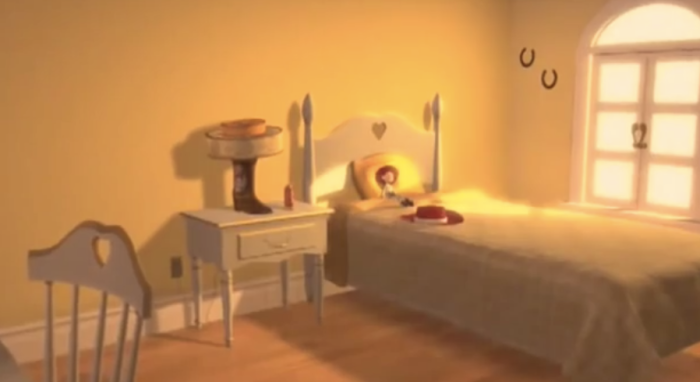
So yesterday I relived my childhood for the gazillionth time by watching Toy Story, a film that needs no explanation and is by far the best thing Disney, Pixar, possibly any animation company, will ever produce. I thought my love and amazement for Pixar couldn’t stretch any further yet today I have learnt something that could well have shocked and left speechless my 10 year old self: Andy’s mom was Jessie’s previous owner Emily!!!
I only realised this after reading a random article today in the Huffington Post by Jon Negroni, but all the evidence is there.
Take for example the famous cowboy hat, Andy’s one is red and has a fade ring where a band used to be. Woody’s is brown with a dark brown band across. Andy’s hat looks remarkably familiar to Jessie’s:
Compare this to Andy’s hat (at top of page) and you can see the faded mark where the white band should have been! Now take the scene where we see Jessie being discarded years ago
Here we see the owner’s larger hat, yet this is not put into the donation box as far as we can see suggesting the owner, Andy’s mom, kept it over all these years, explaining the fading.
As Negroni points out:
“We don’t know the first name of Andy’s mom. We don’t know Emily’s last name. We know that Andy’s hat and Emily’s hat are the same. We know that Emily is old enough to be Andy’s mom. We definitely know that Pixar is perfectly capable of sneaking this in without being overt about it.”
And that’s it folks, a blindingly obvious, yet extremely clever bit of storytelling that encompasses elements of destiny and redemption. Now I’m off to cry a bit more over the scene with Weezy the unwanted penguin!
If a picture can paint a thousand words then I often think the same can be said about speeches, take these two from President Barack Obama, one at the very start of his euphoric presidency, the other a mere few months ago after years of gridlock and what many commentators are calling, disappointingly underwhelming progress.
Obama 2008 victory speech: “It’s the answer that led those who have been told for so long by so many to be cynical, and fearful, and doubtful of what we can achieve to put their hands on the arc of history and bend it once more toward the hope of a better day.”
Obama 2014 State of the Union Address: “Fine, I’ll go it alone. “I’ve got a pen, and I can use that pen to sign executive orders and take executive actions and administrative actions that move the ball forward.”
The Obama years, like that of many presidencies, have had their fair share of highs and lows, successes and failures, yet one word accurately sums up his time as leader of the free world, ‘frustration’. American politics has in the last few years reached such an extreme level of bipartisanship that the majority of discussion that take place nowadays within congress does so amongst a backdrop of mistrust and paranoia, each side accusing the other of playing for political points and not having the interest of the country at hand.
This is of course not entirely Barack Obama’s fault, the very nature of the American political machine has the power to steal the wind from the sails of any executive administration shall they be unfortunate enough to suffer a downturn in the midterm elections and lose control over the upper or lower houses. This is exactly what happened to Obama in November 2010, with approximately 82 million American’s voting in total, the Democratic Party suffered a string of critical defeats at the hands of the GOP who gained a total of 63 seats in the House of Representatives, recapturing the majority. What is stunning about these results is that this seat change was the largest of any US midterm election since the republican’s under Joseph Martin lost 75 to Sam Rayburn’s Democrats in November 1948.
This balance of power divide has over the last few years mainly played out in the area of economics, many democrats hopes of increasing government spending to grow their way out from the ‘fiscal cliff’ and to tax big business and the super wealthy more have been frustrated and watered down by many republicans in the House. Before the midterms Obama had decided to be bold, the initial stimulus package totaled a staggering $800 billion; Obama in his first major legislative action was spending more money that George W Bush had spent on wars in Iraq and Afghanistan. Yet even here, when the country was desperate for the federal government to step in only 3 republicans voted in favour of the ‘American Recovery and Reinvestment Act’, it passed but only just, this would be a sign of the road ahead. The bill was large in scope but comparatively small in application, 1/3 was spent on tax cuts, 1/3 was injected into state budgets and the remainder was spent on infrastructure and development. These capital injections were spread out over a long time-frame and had a subdued initial impact; at the start many workers believed their employers were responsible for a rise in their pay checks and not Washington.
On the Foreign Policy front Obama has had more success, he has ended and withdrawn combat forces from the war in Iraq and after years of attrition is on the precipice of doing the same in Afghanistan. Great campaigning on his part has enabled the repealing of the policy known as ‘don’t ask, don’t tell’, enabling all of those within America’s armed forces to serve with dignity. He has made repeated attempts to contribute to solving the problem which has dogged American political leaders for decades, the solution to the Israel-Palestine issue, but still no breakthrough looks to be in sight. He has also looked to improve America’s relations with the emerging global powers, most notably Brazil and India. In the eyes of most Americans however his biggest success comes in the form of finally ending the decade long hunt for Osama Bin Laden in an event that seems more theatrical in the flesh than Hollywood could make it out to be in ‘Zero Dark Thirty’.
Yet there have been areas where things have gone less than expected, before he came into office one of Obama’s central goals was to close down once and for all the thing that embodied the great contradiction of the American philosophy of peace, freedom and liberty, Guantanamo Bay. This facility on the Cuban coast is still running today although many inmates have been released or rehoused in other just as brutal facilities. Add to this the American policy of rendition and the fallout in relations with many foreign governments, most notably Germany over U.S. spying allegations, as well as a step back in relations with Russia and a kind of equilibrium in judging Obama’s foreign policy is restored.
The policy which Obama will most be remembered for once he leaves office however will undoubtedly be the one that, whether he likes it or not now bears his name, ‘Obamacare’. Having grown up in a country that prides itself on its National Health Service and its central premise of putting patient care before profit I have always been shocked and concerned with the views of many American politicians over the last few years on this subject. Health care reform had been the democratic dream for the last half a century; it had come close to being realised under the Clinton administration and Obama’s determination to ‘finish the job’ characterises the hope and vision that still adheres him to so many. Yet the battle that was about to be played out crystallised just how divided American politics had become.
On the left Obama was attacked by liberals for only wanting to reform the health care system and not completely restructure it with an advanced and extended version of Medicare. On the right, the sheer scale and cost of the proposed changes, mixed with a deep opposition to anything ‘Obama tainted’ left the majority of republican’s to want to kill the bill through any means necessary. Even from within his advisory circle Obama faced opposition, his chief of staff Rahm Emmanuel (now mayor of Chicago) and his own political right hand man David Axelrod felt the approach was too costly at a time when the country was facing one of the worst financial crises since the 1929 Great Depression.
Driven by the memory of his mother’s final months, as well as the recent passing of Democratic veteran and long-time health care supporter Ted Kennedy, Obama would defy his aides and the odds to pass his signature legislation. The Affordable Care Act would continue to unite his opponents through his re-election but would save many within America, especially those with pre-existing conditions, from paying incalculable premiums just to receive treatment; many would receive a basic standard of healthcare for the first time.
The Obama 2012 election fight can be seen more as a defeat for the republicans who, in picking Mitt Romney, a man who could make even David Cameron look like ‘one of the gang’, derailed their own chances of election, gifting Obama 4 more years. The Obama 2012 campaign interestingly had uncanny similarities with the Bush 2004 re-election campaign, in Bush’s case the war in Iraq was failing as the country verged on civil war, for Obama it was high unemployment and lack of major economic growth, both men would make the case that they needed extra time to finish the task. Obama, like Bush knew that if he could increase voter turnout, speak to and reach more voters than before, his chances of re-election would rapidly increase, especially when his opponent was publically talking about why ‘47% of voters were never going to vote for him’, an error of grave proportions. In the end this tactic would work flawlessly, Obama would go onto win re-election by 2.8 percentage points.
So far the main thrust of Obama’s second term has been on decreasing the national debt, putting more American’s back to work and tackling the emotive issue right across America of gun control. On these issues the American economy is growing, jobs within the public and private sectors are being created, although many would argue that this is not happening fast enough. The fight over gun control has been one that Obama, with a little bit of help from our own Piers Morgan, has took to the republicans and the scarily brainwashed but highly influential NRA. Why many within America still feel the need to carry weapons is beyond my comprehension, let alone military grade assault rifles with ammunition clips designed for the battlefield and not the communes of Aurora or the silent streets of Sandy Hook. The campaign for new gun legislation is now fizzling out however, an assault weapons ban was been revoked by Senate Democrat leader Harry Reid because it had fewer than 40 supporters, that’s in a chamber which includes 55 democrats! The current proposals now focus on ‘universal background checks’ which is a positive step but one that total fails to grasp the real issue.
Obama has therefore had many ups and downs during the last 4/5 years; he has achieved success in many areas but has also suffered setback and frustration in many others. The next almost 3 years will be judged first and foremost on how the American economy develops and the amount of jobs created. The classic American aspiration of rising into a thriving middle-class has long since evaporated, yet I do believe that Obama still has the time to carefully apply the defibrillators and bring the dream, and the democratic 2016 election chances, back to life.
It is with a rare sense of urgency that I have created this blog, a feat which I have been meaning to achieve for some time, and for the very first post (of hopefully many unless those who predicted the millennium bug were 14 years off) I want to talk about the ‘youth’ and politics.
My own interest in politics is linked to my passion for news, every since the age of about 10 or 11 years old I can remember at least watching or reading about current news at least once or twice a day. It has reached a stage where it is now so crucial to my morning routine that I do it subconsciously like the making of breakfast or the smashing of the alarm clock against the wall wishing that 10am lecture would go away. Yet from some of the local campaigning I have done and the general perception I get from speaking to many fellow young adults there is am increasing ambivalence towards politics and particularly the feeling that many have that politics is something that doesn’t affect their lives.
The undeniable fact however is that, no matter your age, background, class or ethnicity, politics does effect (praying that I have used affect and effect correctly here) everyone in some degree. Today I went to a talk by labour’s Shadow Health Secretary Andy Burnham, here he talked at length about the increasing threat and challenges our NHS faces under the increasing privatisation brought about by the Tory ideology that profit should come before the patient. Now almost all of us at some stage through our lives will need to use the services provided by the NHS at least once, whether this be for a check-up through to major surgery. The NHS is the one aspect of government that unites us all, I urge any activists, the next time you are out on the doorstep and somebody uses the expletive “but your all the same” (yes it is that offensive) ask them whether they have ever used the NHS and just pause, I would love to hear the results.
All of us interested in politics have a duty to show others that what we ourselves are passionate for matters to them also. Of course this issue of privatisation is also affecting our education, no student at The University of Birmingham needs to be reminded of this. The recent actions of ‘DefendEducation’ (on a side note someone really needs to explain to them that if you let a banner go from its highest point it will inevitably fall down) and the small group of violent individuals that came to campus last Wednesday have given this topic mass publicity, most of this has been negative publicity admittedly but has at least got the issue firmly out into the open. It has been good to see many students actively, in a peaceful way, oppose the increase in tuition fees and the changes to the institution of UK higher education.
My hope for the future is that we see more young people actively engaging in politics in areas that matter to them, I strongly believe that if this happens we will not only have a better more balanced political debate, we will also have a societal fabric that is stronger, more resilient and not afraid to speak its mind. If these changes occur it will not just be us in politics that benefit but the entire country too (yes that includes you Scotland #BetterTogether)
For the two people interested, the next few blogs will be much lighter and entertaining, with hints of American politics sprinkled throughout!


 reputation of brand Britain. I had lunch with the DCG who explained the brief outline of my role which was to assist him and other members of the consulate team in certain upcoming areas of work, the main one being planning, organising and then going on a diplomatic 3 day visit to North Dakota. I had a security meeting which as well as going through your standard fire safety policy gave me a good insight into how the consulate maintains the safety of its staff via multiple means.